
Why This Work Exists
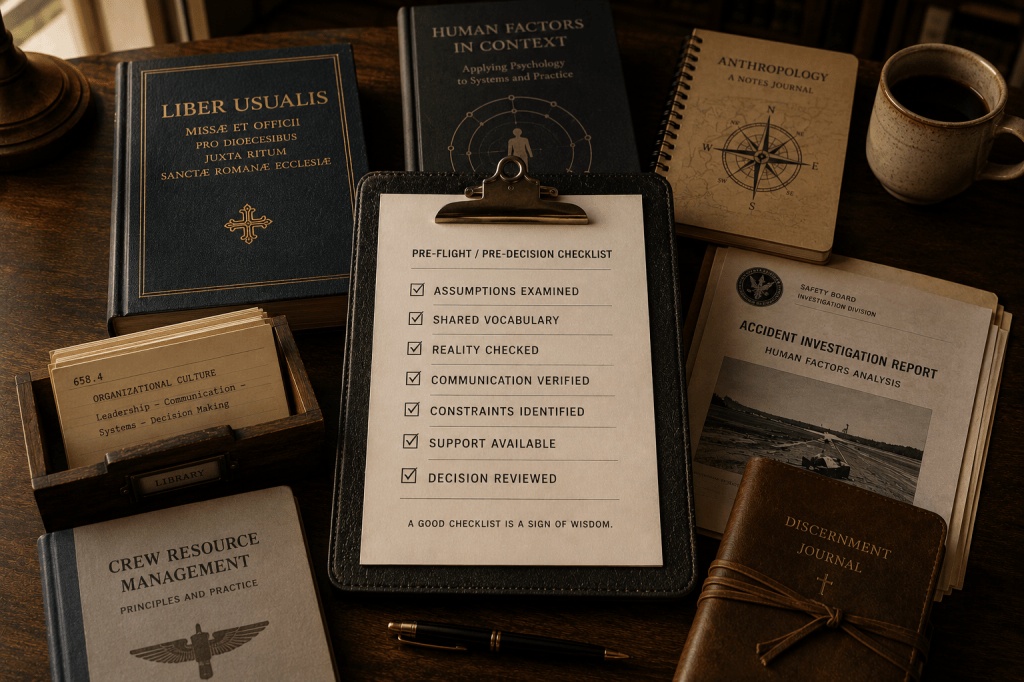
People occasionally ask how someone with a background in sacred music, aviation accident investigation, trauma recovery, organizational culture, monastic spirituality, human factors, leadership, anthropology, and a seemingly endless collection of unrelated interests ended up getting into organizational consulting.
The short answer is that I have always been interested in the same question:
How do people make sense of reality, especially when reality becomes difficult, ambiguous, or painful?
The longer answer takes a little more explanation.
For most of my life, I have been a student of systems.
Sometimes those systems were organizations.
Sometimes they were religious communities.
Sometimes they were musical traditions.
Sometimes they were hospitals.
Sometimes they were families.
And sometimes they were my own mind.
Over time, I began noticing that many of the same principles appeared everywhere.
Organizations fail for reasons that look remarkably similar to aviation accidents.
Institutions develop blind spots in much the same way individuals do.
Teams struggle when assumptions remain hidden.
Communication breaks down when people believe they share definitions but actually do not.
Recovery often begins when someone asks a better question.
The fields may differ.
The patterns often do not.
Why “The Body Keeps the Checklist”?
The name operates on several levels.
Most people immediately recognize the connection to trauma and memory.
Our bodies remember experiences long after our conscious minds have forgotten them. Habits, reactions, instincts, and survival strategies often persist even when the stories behind them become fragmented or inaccessible.
But there is another meaning.
The word corporation comes from the Latin corpus — body.
Organizations are bodies too.
They remember.
They develop habits.
They accumulate scars.
They create workarounds.
They inherit assumptions.
They build cultures.
They preserve stories about themselves.
Like individuals, organizations often carry histories they do not fully understand.
And then there is the checklist.
In aviation, checklists exist because expertise alone is not enough.
Highly intelligent, highly trained people still make mistakes.
Stress affects judgment.
Fatigue affects perception.
Assumptions affect decision-making.
Memory is fallible.
Checklists are not evidence of weakness.
They are evidence of wisdom.
They acknowledge reality as it is rather than as we wish it to be.
The Body Keeps the Checklist sits at the intersection of these ideas:
Human beings remember.
Organizations remember.
Systems remember.
The question is whether we learn from what they are trying to tell us.
Learning from Failure
Some of the most influential lessons I have learned did not come from classrooms.
They came from failure.
My own.
Other people’s.
Institutional failures.
Systemic failures.
Failures of communication.
Failures of leadership.
Failures of accountability.
Failures of imagination.
I have spent years studying aviation accidents, particularly through the lenses of Human Factors, Crew Resource Management (CRM), and Aeronautical Decision Making (ADM).
What fascinates me is not catastrophe itself.
It is the chain of assumptions that precedes catastrophe.
Rarely does a disaster emerge from a single mistake.
More often it emerges from a series of small misunderstandings, unchallenged assumptions, communication breakdowns, incentive structures, and organizational blind spots.
By the time the final failure becomes visible, the opportunities for correction have often been shrinking for months or years.
Organizations frequently experience similar dynamics.
The warning signs are present.
People notice them.
Questions arise.
But assumptions remain unexamined.
Conversations remain incomplete.
Reality and the official story begin drifting apart.
The resulting damage can be profound.
The Human Side of Systems
My academic background is unconventional.
I accumulated nearly 170 credit hours across multiple disciplines before eventually concentrating in sacred music and organ performance.
Along the way I studied anthropology, sociology, communications, psychology, history, theology, leadership, and organizational behavior.
What emerged was not specialization in a single field.
It was pattern recognition.
I became interested in the spaces between disciplines.
The places where one field’s assumptions become visible because another field asks different questions.
As an organist and sacred musician specializing in Gregorian chant and sacred polyphony, I spent years immersed in traditions that evolved over centuries.
Music taught me something important:
Complex systems require listening.
A choir succeeds when individuals hear both themselves and one another.
A polyphonic texture depends on relationships, not isolated parts.
The same is true of organizations.
The same is true of leadership.
The same is true of culture.
Monastic Lessons
At one point I spent time with Trappistine nuns during a discernment retreat.
In fact, I was apparently one of the last people in the country to learn that Michael Jackson had died because I was making cheese with nuns when the news broke.
While I never entered monastic life, I learned something valuable there.
Discernment is not the same thing as decision-making.
Modern organizations often move quickly.
Monastic traditions understand the importance of paying attention.
Of noticing.
Of listening.
Of sitting with uncertainty long enough to understand what is actually happening.
Many organizational problems are not caused by a lack of intelligence.
They are caused by a lack of discernment.
People rush toward answers before fully understanding the question.
The Work
Today my work draws from an unusual combination of influences:
● Human Factors
● Crew Resource Management
● Aeronautical Decision Making
● Systems Thinking
● Organizational Culture
● Leadership Studies
● Anthropology
● Communication Theory
● Trauma Science
● Sacred Music
● Monastic Discernment
● Failure Analysis
The common thread is simple:
I help people identify assumptions before those assumptions become expensive.
Sometimes that means helping teams establish shared vocabulary.
Sometimes it means surfacing hidden constraints.
Sometimes it means improving communication and decision-making.
Sometimes it means helping organizations recognize the difference between appearing healthy and actually being healthy.
I am particularly interested in moments when someone says:
“Well, now that you’ve put it that way…”
Those moments often signal that something important has become visible.
A hidden assumption.
A misunderstood term.
An unspoken fear.
A flawed process.
A better question.
Better Questions
One lesson has followed me throughout my life.
The quality of our answers is limited by the quality of our questions.
Organizations often spend enormous resources solving the wrong problem because nobody stopped to ask whether everyone meant the same thing in the first place.
What does accountability mean?
What does trust mean?
What does culture mean?
What does success mean?
What does “fine” mean?
Those questions sound simple.
They rarely are.
The work of resilience, leadership, and organizational learning begins by making invisible assumptions visible.
That work is not always dramatic.
Sometimes it is a conversation.
Sometimes it is a checklist.
Sometimes it is a difficult question asked at exactly the right moment.
But in my experience, those moments are where meaningful change begins.
That is the work of The Body Keeps the Checklist.
And I believe it is work worth doing.


Leave a Reply