
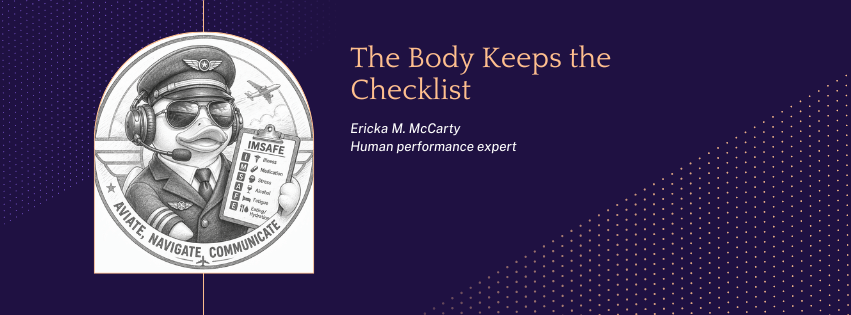
The Body Keeps the Checklist: Insights from Aviation Psychology for Navigating Trauma
The Body Keeps the Checklist
A Black Box Report from Inside a Psychological Crash
The Body Keeps the Checklist is a hybrid memoir and field manual about what really holds when your mind goes down hard and the story of your life disappears.
In the summer of 2025, childhood memories I’d suppressed for 35 years broke through so violently that my autobiographical memory fractured. I spent weeks in a dissociative fugue state: I couldn’t always remember my name, my history, or where I was in time. What remained was not insight, inspiration, or identity.
What remained was procedure.
Drawing on a lifelong obsession with aviation accidents and human factors, plus decades as a trauma client, I treated my collapse the way the NTSB treats a crash: as a system failure to be survived first and investigated later. I used aviation’s core rule—aviate, navigate, communicate—as a nervous-system checklist when higher thinking was offline. I leaned on The Body Keeps the Score as a mental quick-reference handbook, Peter Levine’s somatic work to track state, ACT and IFS to defuse from terrifying thoughts, and years of structured improvisation training as a classical organist and CW (Morse code) operator to “chair-fly” calling 911 and handing myself off to help.
This book is the black box report from that event.
It weaves narrative and framework to show, in concrete detail, how to:
- Stabilize (“aviate”) when you can’t yet make sense of what’s happening
- Orient (“navigate”) when memory and identity are unreliable
- Reach for help (“communicate”) when every instinct says contact is unsafe
The Body Keeps the Checklist is not a replacement for therapy. It’s a companion for people in distress and for the clinicians who work with them—focused on sequencing, safety, and state. Its central claim is simple: meaning-making and deep processing only work when your body is regulated enough to detect error, reality-check, and integrate. You don’t need perfect insight to start. You need a small set of practiced procedures that default toward life when everything else is degraded.
My hope is that the lessons I paid dearly to learn can be trained more gently in others: giving survivors and practitioners a shared language for “flying the plane” long enough for the other trauma modalities to do their work—and for more people to walk away from crashes most of us never get to describe.


