

Why I Do This Work
People sometimes ask how someone with no degree, nearly 170 credit hours, a background centered largely around sacred music, years of serious illness, a fascination with aviation accidents, a history of trauma treatment, and an apparent inability to stay within a single academic discipline ended up interested in organizational consulting.
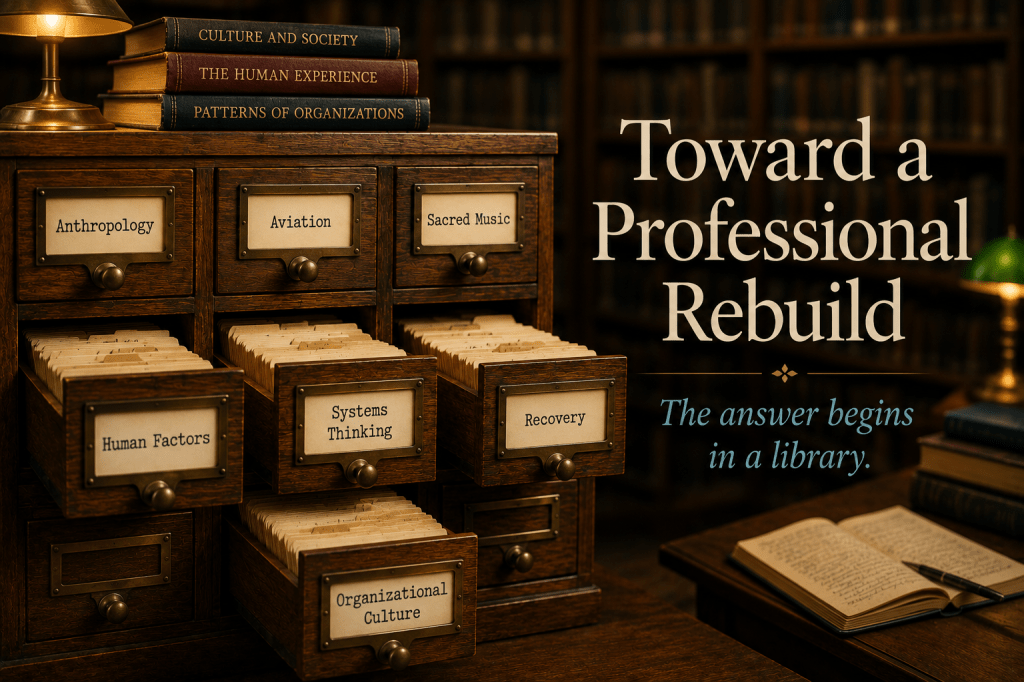
The answer begins in a library.
Or more accurately, several libraries.
Because long before I knew words like systems thinking, organizational culture, human factors, autoethnography, or participant-observer research, I was simply trying to understand how the world worked.
And if I’m being completely honest, I was also trying to survive it.
The Library Cryptid
One of my earliest memories of school involves a class trip to the elementary school library.
My classmates ran toward the picture books.
I ran toward nonfiction.
I wanted answers.
How did airplanes work?
Why did people behave the way they did?
How did governments function?
What happened in history?
Why did some things succeed while others failed?
I wasn’t interested in stories because I wanted escape.
I wanted explanations.
The librarian noticed.
While my classmates received Dr. Seuss and Junie B. Jones, she handed me Helen Keller’s autobiography.
That was probably the moment my fate was sealed.
Years later, in high school, I became what I jokingly call a library cryptid.
I spent so much time there that if the office needed me, they often checked the library before checking my classroom.
This was not entirely unreasonable.
There was a decent chance I was shelving books, helping another student find research materials, checking out books at the circulation desk, or disappearing into the nonfiction stacks with books from five entirely unrelated disciplines.
The librarian frequently signed notes saying she needed my help.
The arrangement became so normal that nobody seemed particularly concerned by it.
Looking back, I realize I was accidentally conducting an interdisciplinary education program.
I just didn’t know that was what it was called.
My Father’s Best Answer
Part of that curiosity came from my father.
He was a Vietnam veteran, electrician, police officer, rural mail carrier, union leader, ham radio operator, and one of the most practical people I’ve ever known.
When I was young, he took me to the public library and showed me the card catalog.
Then he said something that would shape my entire life:
He couldn’t answer all my questions.
But this was a good place to start.
At the time, neither of us fully understood why I had so many questions.
Neither of us fully understood what I had already survived.
He knew something wasn’t right.
He knew there were wounds.
He knew there were things I wasn’t saying.
But he lived in a time and place where the available tools were limited.
So he gave me the best gift he could:
Permission to keep learning.
Permission to keep asking questions.
Permission to find my own way.
That gift may have saved my life.
A Messy CV and an Unexpected Education
On paper, my résumé is unconventional.
Depending on your perspective, it is either wonderfully interdisciplinary or a complete disaster.
Possibly both.
I accumulated roughly 170 college credit hours.
Most eventually concentrated in sacred music and organ performance.
Before that happened, I wandered.
Anthropology.
Sociology.
Marketing.
History.
Theology.
Communications.
Psychology.
Anything that caught my attention.
The result is that I never became a traditional specialist.
Instead, I became something closer to a translator.
Someone who moves between disciplines looking for patterns.
The advantage of that path is that I often notice questions that specialists don’t ask—not because they’re incapable of asking them, but because deep expertise can sometimes make certain assumptions invisible.
An accountant sees the world through accounting.
An engineer sees it through engineering.
A lawyer sees it through law.
An operations manager sees it through operations.
Those perspectives are valuable.
But they can also narrow vision.
Sometimes organizations need someone willing to raise a hand and ask:
“Can we define what we mean by that word before we spend six months arguing about it?”
The Expensive Cost of Shared Vocabulary
One of the most common problems I encounter is the illusion of shared understanding.
A room full of intelligent people discusses:
innovation
accountability
efficiency
leadership
culture
excellence
quality
Everyone nods.
Everyone agrees.
Everyone believes consensus exists.
Then six months later, everyone is frustrated.
Because nobody realized they were using the same words to describe different realities.
One person’s accountability means ownership.
Another person’s means punishment.
One person’s innovation means experimentation.
Another person’s means process improvement.
One person’s efficiency means reducing waste.
Another person’s means reducing people.
The disagreement wasn’t about the goal.
It was about the assumptions hidden beneath the words.
The annoying question often saves enormous amounts of time:
“What do each of us mean when we say this?”
Failure Became My Teacher
My life has given me extensive experience with failure.
Not because I sought it out.
Because eventually everyone encounters it.
Illness.
Burnout.
Grief.
Institutional failures.
Trauma.
Loss.
Recovery.
More recovery.
And then some additional recovery for good measure.
In 2021, my father died.
Years of caregiving, home hemodialysis, chronic stress, grief, and unresolved trauma eventually caught up with me.
In 2022, I spent roughly four months in hospitals.
Sepsis.
Gastroparesis.
Surgeries.
Feeding tubes.
Complications.
The body eventually collected debts that the mind had spent decades pretending did not exist.
Then came 2025.
Homelessness.
Extreme stress.
Sleep deprivation.
A dissociative fugue state.
Psychosis.
Flashbacks.
Delusions.
Moments when I did not know my own name.
Moments when reality itself became unreliable.
One of the recurring delusions involved believing that seeking help would expose me to hostile actors disguised as first responders.
Eventually I had to reality-check my way through weeks of cognitive distortion before I could make a 911 call.
What fascinates me now is not the collapse.
It is the survival.
Because somehow, despite losing access to large portions of my autobiographical memory, certain systems remained online.
Checklists.
Procedures.
Human factors principles.
Structured decision-making.
Reality testing.
Sense of gallows humor.
The same concepts that appear in aviation, emergency response, and crisis management.
The black box remained intact.
Autoethnography and Failure Modes
Today, I sometimes joke that I am a failure mode expert.
I only halfway mean it as a joke.
Much of my work is autoethnographic.
I study my own experiences not because they are uniquely important, but because they provide data.
What failed?
What held?
What assumptions proved wrong?
What interventions helped?
What warning signs appeared years before the crisis?
What systems amplified the problem?
What systems reduced it?
Those questions apply equally well to individuals and organizations.
Hospitals ask them.
Aviation investigators ask them.
Engineers ask them.
Organizations should ask them too.
Toward a Professional Rebuild
One of the most influential books I read in high school was Charles de Gaulle’s Toward a Professional Army.
What fascinated me was not that he eventually became president of France.
It was that he spent years advocating ideas that many people ignored.
Years spent preparing without knowing whether history would ever call upon him.
Then one day it did.
Most of us will never lead a nation.
Most of us should not.
But everyone eventually faces the challenge of self-governance.
How do you rebuild after failure?
How do you continue after loss?
How do you maintain dignity when circumstances suggest surrender?
How do you take the next step when the path is unclear?
Those questions are universal.
That is why I call this chapter Toward a Professional Rebuild.
Because rebuilding is not merely personal.
It is procedural.
It is ethical.
It is practical.
And it is often far less dramatic than people imagine.
Sometimes rebuilding means therapy.
Sometimes it means sleep.
Sometimes it means updating documentation.
Sometimes it means admitting a process no longer works.
Sometimes it means finally asking the question everyone has been avoiding.
The Human Side of Systems
For much of my life, I lived primarily from my intellect.
One therapist described me as living “from the eyeballs up.”
That felt accurate.
Feelings seemed unreliable.
Logic felt safer.
The irony is that years of studying systems eventually taught me something unexpected:
Feelings are not facts.
But they are data.
Trust is data.
Psychological safety is data.
Belonging is data.
Confusion is data.
Burnout is data.
Disengagement is data.
Organizations often struggle because they measure what is easiest to count rather than what is most important to understand.
KPIs matter.
Metrics matter.
Performance indicators matter.
But many of the forces driving organizational success or failure remain difficult to quantify.
People know when they are respected.
People know when they are ignored.
People know when leadership communicates clearly.
People know when they do not.
Ignoring those realities because they are difficult to measure does not make them less real.
The Work
Today my work sits at the intersection of:
systems thinking
organizational culture
human factors
anthropology
communication
leadership
resilience
failure analysis
I help people have what I call:
“Well, now that you’ve put it that way…”
moments.
Those moments often signal that an invisible assumption has become visible.
A hidden constraint has been named.
A misunderstanding has been clarified.
A problem has been reframed.
A better question has emerged.
I am not particularly interested in perfection.
Perfection is not a systems strategy.
Resilience is.
My goal is helping organizations and individuals become more resilient, more aware, and more capable of learning before problems become crises.
The library kid who spent years hiding among the nonfiction stacks thought knowledge alone could solve everything.
The adult who emerged from hospitals, grief, trauma treatment, homelessness, and recovery knows better.
Knowledge matters.
Structure matters.
Metrics matter.
But human beings matter too.
The challenge is learning to hold both.
That is the work.
And in my experience, it is work worth doing.
 The Body Keeps the Checklist
Leave a comment